While "Jai Ho" won best song from 2008's Slumdog Millionaire, it was an English translation of the song in the soundtrack. "Naatu Naatu" from the 2022 Telugu-language action movie RRR was the first and only non-English song to have won an Oscar. The vaunted progressivism goes out the door when given a chance to reward music from Native Americans -- and correct the gross caricatures of "Indian music" from movies of years past. The Academy's songwriting members went with a hit song from a hit movie about one of the most ubiquitous toys in America.
Monday, March 11, 2024
No, Really, I Come to Bury Oscar
While "Jai Ho" won best song from 2008's Slumdog Millionaire, it was an English translation of the song in the soundtrack. "Naatu Naatu" from the 2022 Telugu-language action movie RRR was the first and only non-English song to have won an Oscar. The vaunted progressivism goes out the door when given a chance to reward music from Native Americans -- and correct the gross caricatures of "Indian music" from movies of years past. The Academy's songwriting members went with a hit song from a hit movie about one of the most ubiquitous toys in America.
Thursday, August 17, 2023
Inside Outside
I guess my take is that when a movie is made sui generis, without any adaptation, skill can bring us to the hidden space inside a character's head and heart -- because there's no deeper understanding around to make a comparison. But when a novel is around to show the depth a great writer can unmask, the movie may be great, but it will fall short. Every musical or movie made based on Les Misérables, whether awesome, awful or indifferent, does not repay the work of fighting through about 1,200 pages of the novel.
Tuesday, August 1, 2023
The Book, Dramatized
I've been a fan of the multi-season biblical drama The Chosen, written by Tyler Thomson, Ryan Hopkins and creator-director Dallas Jenkins. Some of that is because it focuses heavily on the disciples, the normal human beings who have to try to navigate life while following Jesus. Some of it is because it features a vision of Jesus I like -- funny, wry and mountain-strong against the injustices the Pharisees and Romans inflict on the people.
Jenkins is the son of writer Jerry Jenkins, who tried to write about the second coming of Christ but was hampered by Tim LaHaye's rigid dispensationalism. After some failed commercial filmmaking Dallas found himself drawn to making religiously-themed movies, but without the preachiness or stodgy demeanor found in many of these films. Asked to provide a video for his church for Christmas 2017, Jenkins created The Shepherd, which became the pilot for The Chosen.
Genuine actors show up on the screen of these episodes -- the first season featured well-known character actor Erick Amari as Nicodemus in a poignant role. Frequent TV guest star Jonathan Roumie exults in humanizing Jesus, Shahar Isaac shows Peter as the leader Jesus needs him to be as well as the uncertain man who will one day deny his Lord. Oklahoma's own Elizabeth Tabish absolutely nails the pivotal role of Mary Magdalene, one of the most important women in Jesus' ministry.
Anyway, The Chosen has been around for awhile now and I didn't intend to write about it. It just gave me an idea. A professor at Westmont University in California named Sandra Richter did a video study on the biblical book of Ruth that could create an excellent screenplay. The Moabite woman who accompanied her widowed, childless mother in law back to Israel and left her own people and homeland. Through a course of fortuitous events -- and some nudging from the mother-in-law -- she catches the eye of a wealthy distant kinsman named Boaz. Eventually they marry and have a son, Obed, who was the grandfather of King David. She is one of the five women named in Jesus' genealogy.
Richter's understanding, which is drawn from 20-some years of studying the Old Testament and the environment of its people, suggests that rather than a romantic entanglement, Boaz takes Ruth in marriage because of her great devotion to her mother-in-law and her own cleverness in getting his attention. The next part is of her own devising, but Richter envisions a union of legal custom and respect growing into love, despite the age differences.
Neither filmed version of Ruth and Boaz's story takes this angle, focusing on romance (1960's The Story of Ruth) or the sanctifying of the biblical characters (2009's The Book of Ruth).
I just kind of thought I'd like to see that version filmed because in my mind, it matched some of the mindset of the creators of The Chosen and it turned Ruth into my favorite book of the Bible. Every now and again, I guess I'm still going to ramble.
Friday, May 6, 2022
Get the Title Right, And...?
Friday, December 31, 2021
From the Rental Vault: Red Notice (2021)
Second, the thieves must be basically good people. Yes, they're breaking the law, but they're not really hurting anyone. Hapless guards may succumb to knockout gas or find themselves locked in a now-empty vault after being outwitted by our clever protagonists, but no one is seriously or permanently injured. They're just having fun and using their great skills to get rich quickly and proceed to their life of ease that precedes the closing credits.
And most of all, there must be some surprising twist that no one saw coming -- in fact, no one even saw that no one saw it coming and this unanticipated twist can send the audience home happy if it's pulled off and rolling their eyes if it isn't.
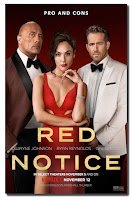
The Netflix offering Red Notice, featuring what should be a power trio of Dwayne Johnson, Ryan Reynolds and Gal Gadot, overlooks several of these important points and thus winds up with an audience that may ask itself, "Why did I watch that?" Johnson is John Hartley, a by-the-book FBI profiler who helps Interpol nab the skilled thief Nolan Booth (Reynolds) until skilled thief Sarah Blake (Gadot) plants evidence for Interpol that Hartley is not an FBI agent at all and gets him thrown into the same Russian prison as Booth. They escape, and Hartley realizes that in order to clear his name, he's going to have to help Booth steal the second of three golden eggs made as presents for Cleopatra so he can turn it over to Interpol. Blake keeps complicating things and eventually the trio must find the third, long lost egg, in order to achieve their individual goals.
The three leads have good chemistry. Johnson and Reynolds are essentially playing themselves and Gadot shows she can pitch in with the quips as well as either of them. But fun dialogue and likable leads only go so far, and Red Notice winds up frequently funny without being at all fun -- the cast is having a heck of a time, but it all stays onscreen and doesn't make the move to the viewer. The set pieces are all predictable -- Johnson will win his with brute strength, Reynolds with slick patter and misdirection and Gadot with smoking hottery diverting the opponent before kicking his butt. And there's too many of them; Red Notice is a nearly two-hour movie that should have been a half-hour to 40 minutes less.
Writer-director Rawson Marshall Thurber, a co-producer along with Johnson, has said that sequels are possible -- but Red Notice in some ways already feels like a sequel. If you're a fan of '80s movies, imagine watching Jewel on the Nile before Romancing the Stone and you'll have a pretty good sense of what it's like seeing Red Notice.
Friday, December 10, 2021
Ouch
Peter Jackson's recent documentary The Beatles: Get Back shows hours of footage shot as the band prepared its final album, Let It Be. The film was shot at the time and only a very truncated version appeared, but Jackson took the many hours available and created a far more complete picture in his eight-hour documentary.
Contrary to the widely-held opinion that John Lennon's second wife, Yoko Ono, broke up the band because of her intrusive presence, Jackson suggests that she didn't have that much impact at all. Although she's frequently around during recording, writing and the rest of the process, she's not pushing her ideas or whatnot into the discussion.
At least one article I read shows that the band broke up not because of anyone's significant other, but because as the four members grew older they found that they had less and less to say together. Their respective muses no longer pulled in the same direction and in order to follow them, "The Beatles" had to become John, Paul, George and Ringo once again, separated from their common milieu. Given the leeway to exercise their own creativity with, say, solo albums or working with other bands, perhaps they could have stayed together when the ideas or the mood struck. That option, for whatever reason, wasn't explored or maybe wasn't even considered possible.
Other reviews have said different things. Amanda Hess, writing at the New York Times, suggests that Ono is actually engaged in her own work of creativity as a performance artist. By being ever-present but always silent, she was offering commentary on how women were marginalized by the rock music culture. Hess thinks this is of a piece with Ono's public comments on that matter and the dedication she puts on her song "Potbelly Rocker."
Folks, can, of course, think what they want about Ono's artistic ability. The idea that she broke up the Beatles overlooks the robust ability of all four men, especially Lennon, to be arrogant elitist asses all on their own. For her 1971 "show" at the Museum of Modern Art, Ono had released flies on the museum grounds which the public was invited to track as they dispersed across the city. I think that says most of what needs to be said about her work (The flies were also sprayed with her perfume to carry her scent, but in reality liquid sprayed on insects often suffocates them).
But the article subhead says that in Jackson's documentary, "Ono is a performance artist at the height of her powers." That's just mean.
Monday, July 12, 2021
Cause and Effect?
When John Cena made his less-than-courageous apology for referring to Taiwan as a country, a number of people speculated that it was the natural result of a well-known side-effect of performance-enhancing drugs that Cena has been rumored -- but not proven -- to have taken.
In a similar vein, when one learns that Hong Kong movie star Jackie Chan said he would like to join the Communist Party of China and that the Beijing government was right to crack down on democracy protestors, one is tempted to remember he has done his own stunts on more than 150 movies and that there is every chance that cognitive-affecting head trauma may have occurred.
Both men, however, share membership in a club of actors that I cannot imagine paying money to watch on screen ever again.
Monday, July 5, 2021
I Kind of Did Believe a Man Could Fly
Of course, it was Christopher Reeve's performance that made it happen, but it was director Richard Donner's vision and he was the one who made the call to cast Reeve. He also got Gene Hackman to play Luthor, another great choice. Superman has its seams -- it's a little long, Ned Beatty's character is pretty much completely out of place and the Marlon Brando casting proved to be a money sponge that in the end added very little to the movie.
Donner fell awry of Alexander and Ilya Salkind while the first two Superman movies were being shot simultaneously, which resulted in him being fired once Superman was released. Richard Lester directed re-shoots for Superman II, which used some of Donner's footage but not enough for him to get credit. A director's cut of Superman II was released in 2006, which combined Donner's completed scenes, some screen test footage of an important point and the Marlon Brando footage that had been tied up in litigation at the time of the sequel's initial release.
In the meantime, of course, Donner had brought out The Goonies as well as the Lethal Weapon series and cemented his place as a box-office director of zippy action movies.
Although the 1970s special effects don't even come close to measuring up to today's technology, they were some of the best available at the time and something Donner insisted on -- as far as it was possible at the time, it had to look like Superman could fly. What Superman did was show that you could tell a real story with comic book characters when you treated them like real people inside their universe of suspended disbelief, making a modern mythology real.
Donner passed today at the age of 91
Saturday, June 26, 2021
Clarity
A pop-culture website that I often read had an item in which the writer worried that the trailer to the upcoming Halloween Kills reveals too much about the movie. Which is a sequel to 2018's sequel to the original 1978 movie that doesn't take into account any of the subsequent sequels and also ignores the rebooted version from "musician" "filmmaker" Rob Zombie and its sequel.
Anyway, the writer thinks the trailer shows too many of the kills by lead psychopath Michael Myers, whose brutal string of slayings is what passes for a plot in all of these movies -- except, of course, for Halloween III: Season of the Witch, which involved cursed Halloween masks.
Halloween (2018) retconned all movies subsequent to the original out of existence, including the original sequel and both alternate timelines that came from it. It "ended" with the unstoppable killer Myers burning in Laurie Strode's (Jamie Lee Curtis) basement. But of course someone who's almost as dumb as the people making these movies unwittingly helps Michael escape to continue killing, and as mentioned above the article worries that too many kills are given away, ruining the movie. When the only appeal of your movie is the supposed inventiveness with which the villain snuffs out human life, you can be certain that you have made a movie that, if karma is real, you will one day be required to answer for.
Tuesday, May 18, 2021
From the Rental Vault: Naam Shabana (2017)
One of the story's most interesting features mostly hamstrings it -- Ranvir Singh's offer to help Shabana gain vengeance before she joins the agency is certainly a different sequence of events than thrillers often follow but it also brackets a large section of the movie as an "in-between" kind of set piece that keeps us from getting to the eventual training and mission sequence that's the point. That disconnect may have hurt Naam Shabana at the box office and put Pandey's plans for other prequels on hold. Pannu is effective as both a talented actress and a butt-kicking heroine, but Pandey's convoluted storyline and extraneous moving parts keep her on the shelf for too much of the movie, even when she's front and center on the screen.
Saturday, March 20, 2021
From the Rental Vault: Buccaneer's Girl, 1950
DeCarlo is Deborah McCoy, a New Orleans singer and entertainer stowing away on a ship later captured by Baptiste (Friend). Though he holds her captive, she escapes and lands at Mme. Brizar (Elsa Lanchester)'s "school for young ladies," or as it is known outside the world of Hollywood's 1950s censors, a brothel. Mme Brizar's students make their money -- and, fingers crossed, catch the eye of an eligible bachelor -- by singing at different parties and entertainments given by New Orleans' upper crust of society. Debbie is astonished to learn that the pirate Baptiste is also a member of that same society, despoiling his fellow aristocrats to fund a relief fund for injured and aged sailors they discard. Although she is drawn to him as Robert Kingston, she finds Kingston engaged to Arlene Villon (Andrea King), another member of New Orleans elite. There is more business than affection in the match, though, especially when the snooty and faithless Arlene is compared to Debbie. If these shoals aren't enough to imperil Kingston/Baptiste, his rival businessman Narbonne (Robert Douglas) is close to trapping Baptiste, aided by the scheming Patout (Norman Lloyd).
The plot seems a little too intricate for its own good and several times it almost is, but director Frederick DeCordova keeps it moving forward when it might falter and draws our attention back to action, fun and romance. The movie is clearly DeCarlo's, giving her the central arc of falling in love with Kingston, spurning him when learning he is engaged and then being romanced by him once he decides to pursue her. Rather than shrink back while the menfolk fence around the set, she's the think-on-her-feet planner of the schemes of derring-do that help our heroes combat the nefarious villains.
Both the script and her performance make DeCarlo's leadership role organic rather than artificial and help make an enjoyable romp, even if not nearly as much of the action takes place on the bounding main as the title might lead one to hope.
DeCarlo would later wind up as Moses' wife in Cecil B. DeMille's The Ten Commandments and as Lily Munster in TV's The Munsters. DeCordova would be the longtime director of The Tonight Show during the reign of late-night king Johnny Carson, and Norman Lloyd would be the patriarchal Dr. Daniel Auchslander on the small screen's St. Elsewhere. At 106, he's still active and performed as recently as 2015.
Monday, December 7, 2020
Over (and Done) Hyped
At Looper, Ziah Grace offers a list of movies that studios hyped, sometimes quite strongly, which never wound up being made or released.
The list of movies hyped that should have never been made or released is somewhat longer.
Tuesday, December 1, 2020
The Road Not Taken, Because the Web Design Was Ridiculous
Sometimes a post title gives away the joke. For those who think they have read many entries and have not yet been introduced to anything they might think of as funny, indulge me, because sometimes amusement is my intention even if not my execution.
In any event, this item at the New York Times is a list of the 25 greatest actors of the 21st century (so far). I didn't recognize the first one and thought I might be able to riff off of that and make fun of the way that I don't know who any of these people are. But I did know a couple of the next four or five and I quit after that because the weird way in which the photos and copy appeared as I scrolled wasn't worth the time spent in order to find out who Times writers Manhola Dargis and A.O. Scott think are the best actors of the first 20 years of the century.
And in any event the headline misleads; Dargis and Scott are considering the best actors on the big screen for the past couple of decades; stage and television actors apparently need not apply.
Wednesday, September 30, 2020
From the Rental Vault: Against All Flags (1952)
Errol Flynn had an unusual worry when he began reading the script for his 1952 swashbucker Against All Flags. It wasn't that the movie had an unrealistic historical setting or featured a clearly Anglo actress as the supposed Princess Patma, daughter of the Moghul Emperor of India. It wasn't that the ship movements depicted onscreen seemed very little affected by the supposed wind (a captain at one point orders his crew, anchored alongside a wharf, to "make ready to come about").
No, the problem was that he was supposed to have a sword fight with a woman and he felt it wouldn't fit with his traditional image as "the bravest guy onscreen." But the woman was Maureen O'Hara, who had by that point gone face-to-face with John Wayne onscreen and John Ford in real life and come up the winner. Director George Sherman had worked with O'Hara before and told Flynn that she could hold her own with swords, pistols or her fists and he'd better get in shape. She could, he did, and the result was 80 minutes of frothy fun on the seas near Madagascar in the year 1700.
Flynn is Brian Hawke, a man pretending to be a disgraced British East India Company officer embittered by ill treatment and seeking to join the Madagascar-based pirates sailing out of Diego Suarez. O'Hara is Prudence "Spitfire" Stevens, a woman captain who inherited her piratical position from her father. She's wary of Flynn but thinks she can use him to get out of Madagascar and enter legal society back in England. Anthony Quinn is Roc Brasiliano, another captain whose desire for Spitfire only magnifies his mistrust of Hawke. Alice Kelley is the aforementioned "Princess Patma."
Hawke tries to keep Patma safe while keeping Brasiliano at a distance and woo Stevens -- in addition to his original mission of locating and disabling the pirates' land-based fortifications so Royal Navy ships can destroy their base.
As mentioned above, it's a completely superficial romp that hits all the right notes -- Quinn glowers and schemes, Flynn swashes, buckles and swaggers about and O'Hara keeps her powder dry while making it clear she is a woman who decides things for herself. Flynn was 43 and his hard-living personal life was taking its toll, but he takes on everything his role demands, even down to a stunt that involved sliding down a sail to the deck with the aid of a rapier thrust through it. He did break an ankle at one point, in a more ordinary scene, which allowed Universal to recast the sets and shoot the B-picture Yankee Buccaneer while he recovered.
Against All Flags has a number of scenes that make a modern viewer uneasy -- the sale of Princess Patma's captured retinue as "brides" is treated with too many jokes in light of what it really represents and Alice Kelley is not in the slightest an Indian or a Moghul, although she and Mildred Natwick as her governess are funny in the right spots. Still, it was a movie made in 1952 and a lot of things about it -- from its special effects to its sensibilities -- are likely to make a modern audience wish them done better. But the solid performances from Flynn and Quinn, as well as the proto-lady warrior played by O'Hara, make it an interesting watch in the sea of similar features.
Thursday, September 24, 2020
Book a Film
Matt Stevens, a designer and illustrator, has a hobby whereby he reimagines contemporary movies as vintage book covers.
The cover art reflects a key feature of the movie (Fight Club's mirror-image boxer is probably a good example). Stevens said the movies aren't necessarily ones he considers the best movies he's seen or which rate highly among critics, just ones he enjoys and gets an idea to illustrate. Which is probably why some of the imaginary book covers are better than the movies they represent.
Friday, September 11, 2020
Trouble
A Disney executive admitted at a conference that its credit thanking the Xinjiang local government for its permission to film in the area -- perhaps granted when said local government was on its coffee break from its attempts to wipe out the Uyghur minority in the region -- "has created issues."
The exec then demonstrated herself a member of the mustelidae family by saying that most of the movie was filmed in New Zealand and just a few shots were filmed in the same region as the many concentration camps in which the Chinese government is holding citizens of its nation who committed the crime of being born of Uyghur heritage. Try transposing that sentence into one that says "only a few of our movie's scenes were actually filmed at Dachau" or "we just used some scenery from Ukraine and we had no idea Stalin's government was starving everyone around us" and you'll see how exonerating it tends not to be.
Still, acknowledgement that the Xinjiang thank-you and the lead actress's support of Hong Kong police actions during anti-democracy crackdowns created "issues" for the movie is a welcome step forward. May their tribe increase.
Thursday, September 10, 2020
Head-Scratcher
I could be mistaken and I haven't dug into this as deeply as have some others, I am sure, but if I read the new Academy of Motion Picture Arts and Sciences diversity initiatives right, a curious little quirk pops up. A previous Best Picture Oscar winner that would meet the minimum standards as described in this Variety article is 1939's unenlightened Gone With the Wind. A previous best-picture winner that would not meet those standards is 2019's Parasite.
It's a shame the Academy backslid so much in those 80 years.
Monday, August 3, 2020
From the Rental Vault: Harlem Nights (1989)
All of the performances are competent; most of the cast had quite a few roles in their filmographies even if only in bit roles. If Murphy's vision had been augmented with some advice on the script and direction, and if he had been able to make up his mind which direction he wanted to take -- comedy, caper flick or high-concept star vehicle -- Harlem Nights could have helped break through some of the stereotyping walls built around African-American directors and their work. Lee and other directors like John Singleton were proving that an African-American-directed movie centered on African-American experiences with an African-American cast didn't have to be a comedy or belong to the "blaxploitation" genre of the 1970s. A critical success for Harlem Nights might have demonstrated such movies could also perform at the box office and broken a lot of barriers (All but the most virulent racists figure out how to deal their differences when it comes to the color green). But the curiously lifeless result of its combined talents kept that from happening, and leaves the movie itself memorable for what it failed to do instead of what it did.
Thursday, May 28, 2020
From the Rental Vault: Agent Vinod (2012)
The espionage business, as shown in movies, are replete with such aspects. Even when they don't incorporate science-fiction elements they show spies who are so high profile it's pretty much impossible to believe that everyone doesn't know who they are as soon as they show up. So a spy movie with musical numbers can in fact work, as long as it doesn't tilt too far one way or the other. Unfortunately the 2012 release Agent Vinod makes the mistake of thinking that matching an excess one way with an excess the other way as a way of walking the tightrope. It turns out not to be.
Vinod (Saif Ali Khan) is put onto the trail of Russian criminals who murdered a colleague after he had learned just a few introductory facts about their planned operation. Armed only with the clue "242," he takes the place of a courier and gets into the orbit of a Tangiers criminal boss who may be ready to sell abandoned nuclear arms. The crime boss's personal physician, Ruby Mendes (Kareena Kapoor) is quite obviously more than she seems, but Vinod doesn't know for which side. Burrowing in more deeply, he finds rogue elements in India's rival, Pakistan, may be trying to acquire the nuke in order to set it off in an Indian city. Only that may not be the end of the conspiracy, and Vinod may wind up with only himself to trust.
Director/co-writer Sriram Raghavan keeps his action sequences taut and compact and doesn't waste too much time trying to make Agent Vinod's squirrelly convoluted plot make any more sense than it has to in the moment. Saif Ali Khan makes a suave and sophisticated leading man who sells the familiar idea of the roguish charmer spy fairly well, but Kapoor is not as well served by the part of Ruby Mendes. With a couple dozen-plus roles in her filmography, she's one of India's most versatile female stars -- but the Mendes role is too flat to let her do much with it beyond some hinted comedy and action of her own. And even though Kapoor and Khan would marry the same year the movie came out, Raghavan and co-writer Arjit Biswas can't bring much of a spark to their onscreen interaction.
Song-wise, "I'll Do the Talking Tonight" is a good macho-bravado tone-setter for the steely-eyed Vinod, adding some Russian-influenced instrumentation to its dance-floor thump."Raabta," a romantic piano ballad played as Vinod and Ruby face down a John Wick-styled hit squad, is an interesting contrast of music and onscreen events.
Vinod was co-produced by Saif Ali Khan and probably intended as a franchise kickoff. But pre-release problems, political missteps and a plagiarism lawsuit added up to a strong box-office headwind that the movie's undecided personality and uninspired execution couldn't sail against.
Tuesday, May 12, 2020
Deja Movie
I found myself liking several of the ones the different writers picked, such as the courtroom drama or the speech about hope in the face of adversity (some might say that my profession includes quite a bit of the latter).
Others I kind of wondered about. One choice is the horror movie's ominous early-scene warning about the dangers that await the unwary travelers. Horror movies are just about nothing but cliché from opening score to closing credits, so it doesn't seem possible to select one of them out of every other minute we see onscreen. But I'll take his word for it because doing otherwise would mean that I have to watch a horror movie and G/O Media doesn't have enough money to get me to do that.