Thursday, January 27, 2022

Old vs. New

I'm late to the party (pal), as Ted Gioia has made a couple of TV appearances talking about his essay on how older music is crowding out new music. 

I think it is, and not just because a huge percentage of new music is, um, gunk. A few years ago a band called Walk the Moon had a very catchy hit called "Shut up and Dance With Me." In addition to being a neat reminder of the classic Pearl Harbour and the Explosions "Shut up and Dance," it was a fun 80s-sounding throwback that topped the US rock charts and hit No. 4 on the Billboard Hot 100 pop chart. The next single managed #4 on the rock chart and #65 on the Hot 100. Two subsequent releases cracked the top 20 on the rock chart but showed up nowhere else.  "Shut Up and Dance With Me" would probably have earned Walk the Moon a couple of top 20 albums back in the 80s and a career that would last at least as long as Loverboy's.

Gioia offers a much more detailed take, but it seems to me the upshot is that the modern audience attention span isn't long enough to keep new bands or performers on top for much more than a song or two. And the music industry responds, which means we never really get to hear how a group or a singer might sound after maturing or gaining experience with songwriting and playing.

Kind of depressing. Think I'll go play some Meat Loaf. Which might mean I'm part of the problem, but since the new music I hear is usually very niche-y in style, there's not much chance of them falling from the charts.

Friday, January 21, 2022

Pun!

Sometimes, it's the sneeze of a clown that causes the problem, not the tears...

Friday, January 14, 2022

Non-Sensible Token

Caleb Scharf, writing at Nautilus, notes some interesting things about one of the latest crypto-currency related crazes, called "non-fungible tokens."

Simply put -- and I admit upfront that I am not at all sure I properly understand this whole shebang -- NFT's are some kind of electronic or online asset to which provenance is unbreakably assigned. If the NFT is a digital image, for example, the same blockchain technology that backs crypto-currencies "marks" one image in such a way that no matter how it is copied, the original is always distinguishable from the copy.

In order to ensure a painting is real, its history is traced from artist's easel to purchaser's rec room wall. Should the history not be available, then recent advances in scientific testing can compare brushstrokes, pain composition, canvas, and so on. So a stolen painting that suddenly resurfaces is tested and can be pronounced real, establishing its provenance.

NFT's, as mentioned, use the same blockchain technology that backs up digital currency. The problem is that, as a part of its anonymity and validity, the computational work in a blockchain is widely distributed -- and highly power-hungry. Environmentalists have been grumbling about the energy use level behind digital currencies, but their defenders can at least point out that such currencies are a means of exchange and might have some utility.

It's hard to say the same about the utility of NFT's. If I take an online image and use it as, say, the background photo of a blog, I really don't care if it is the original. And if some people do care, unless we're talking about a request to take down a copyrighted image I don't care that they care.

Perhaps it's because I'm some middle-aged dweeb who has a job in the real world and deals with people who live in it, interacting with them as real people and thinking that's of some value that I can't stop thinking, every time I hear people talk about NFTs: "That's just about the stupidest thing I've ever heard in my life."

Until someone tells me how much money this or that NFT sold for, that is. That's even stupider.

Sunday, January 9, 2022

It Might Be Just What We Needed!

Gen-X single men who have been exhibiting our generation's well-known slackitude, our time has come!

Our task is before us, gentlemen. I have every expectation we will acquit ourselves with honor and distinction.

Saturday, January 8, 2022

Data Error?

Writing for the American Council of Science and Health, Cameron English outlines "four awful science journalism trends that should die in 2022."

The majority of the trends have been exposed or exacerbated by the pandemic and have a common thread as English presents them. They mainly fumble when that old-fashioned quality of "nuance" is required. Correct facts are used as the basis for significant overreaction, alternative explanations are shoved to the side, the amazing diversity and curiosity of science is covered over by being lumped as "the science" or "science," a point of view that overlooks the reality that settled ideas are usually not a goal, but a scientist's biggest target.

I know a few scientists and was in college with a bunch of students exploring its various fields, so I echo Isaac Asimov's statement that what makes scientists' eyes light up are data that seem a little wonky. Their greatest joy is not in saying "Eureka!" although figuring out a problem is a welcome development. No, a scientist's favorite phrase is, "Hmm. That's odd."

The kinds of errors English describes come from science journalists who have gotten so tribal in their outlook that oddity is crushed, ignored, explained away or called an "outlier." But in reality oddity means it's time to crack the knuckles, lean forward over the microscope or computer or data chart and say, "The game's afoot indeed."

If they are Sherlock Holmes fans, that is.

Sunday, January 2, 2022

A Magical Disappearing Act

According to this story at MSN, viewers of the recent HBO 20th anniversary special of the release of the first Harry Potter movie learned several things. Ten, in fact, although when you read the story you'll find more than one that was already known to most fans of the series.

You'll also find out that an entire reunion special about the movies, which are based on some of the best-selling books of all time, can be done with their author shown in only B-roll archive footage talking about how hard it was to cast the title character.

You see, Potter author J.K. Rowling has staked her claim on the idea that gender is a fact. In an essay on her website she makes this and similar statements several times; acknowledging the reality of transgender people while insisting that those who claim there is no material difference between folks who transition to a gender and ones who are born to it are incorrect. Much of modern culture disagrees, and so naturally both sides frequently and calmly exchanged ideas as they sought to open everyone's mind to new points of view.

Just kidding! We live in a world where instead of flying cars scientists gave us Twitter, so the people who tweeted the more hateful, divisive, dismissive, inflammatory and angry posts the fastest won and we're treated to a spectacle of a Harry Potter reunion and reminiscence special that left out the woman without whom none of it would have happened. Whether one believes her views on gender are accurate or inaccurate and harmful, it's simply ludicrous to leave her out of a discussion of these characters and stories.

Rowling isn't completely erased, mind you. She appears in the aforementioned archive footage and is referred to now and again during the discussions. She's talked about a little, kind of the way that the late Richard Harris and Alan Rickman are. Of course, they're dead, while Rowling isn't. She's just an un-person, if I may borrow a term from another author.

Who made every ungrateful wretch in that special stinking rich.

Friday, December 31, 2021

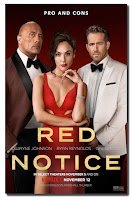
From the Rental Vault: Red Notice (2021)

Caper movies walk a fine line. The centerpiece is usually a skillful and daring heist performed against impossible odds and armies of guards. Something has to be stolen, but a caper movie is supposed to carry itself lightly, so the theft may be committed against an evil opponent, a faceless corporate museum or a private hoarder unwilling to share his or her treasures with the world. Otherwise an audience may disconnect once it realizes it's cheering for criminals and some poor person is going to suffer the loss of a treasured and perhaps irreplaceable heirloom or beloved personal item.

Second, the thieves must be basically good people. Yes, they're breaking the law, but they're not really hurting anyone. Hapless guards may succumb to knockout gas or find themselves locked in a now-empty vault after being outwitted by our clever protagonists, but no one is seriously or permanently injured. They're just having fun and using their great skills to get rich quickly and proceed to their life of ease that precedes the closing credits.

And most of all, there must be some surprising twist that no one saw coming -- in fact, no one even saw that no one saw it coming and this unanticipated twist can send the audience home happy if it's pulled off and rolling their eyes if it isn't.

The Netflix offering Red Notice, featuring what should be a power trio of Dwayne Johnson, Ryan Reynolds and Gal Gadot, overlooks several of these important points and thus winds up with an audience that may ask itself, "Why did I watch that?" Johnson is John Hartley, a by-the-book FBI profiler who helps Interpol nab the skilled thief Nolan Booth (Reynolds) until skilled thief Sarah Blake (Gadot) plants evidence for Interpol that Hartley is not an FBI agent at all and gets him thrown into the same Russian prison as Booth. They escape, and Hartley realizes that in order to clear his name, he's going to have to help Booth steal the second of three golden eggs made as presents for Cleopatra so he can turn it over to Interpol. Blake keeps complicating things and eventually the trio must find the third, long lost egg, in order to achieve their individual goals.

The three leads have good chemistry. Johnson and Reynolds are essentially playing themselves and Gadot shows she can pitch in with the quips as well as either of them. But fun dialogue and likable leads only go so far, and Red Notice winds up frequently funny without being at all fun -- the cast is having a heck of a time, but it all stays onscreen and doesn't make the move to the viewer. The set pieces are all predictable -- Johnson will win his with brute strength, Reynolds with slick patter and misdirection and Gadot with smoking hottery diverting the opponent before kicking his butt. And there's too many of them; Red Notice is a nearly two-hour movie that should have been a half-hour to 40 minutes less.

Writer-director Rawson Marshall Thurber, a co-producer along with Johnson, has said that sequels are possible -- but Red Notice in some ways already feels like a sequel. If you're a fan of '80s movies, imagine watching Jewel on the Nile before Romancing the Stone and you'll have a pretty good sense of what it's like seeing Red Notice.